Categories

Rajnath Singh, CM Yogi inaugurate first BrahMos missile batch from Lucknow facility
On October 18, 2025, India marked a landmark day in its defence manufacturing history: Union Defence Minister Rajnath Singh and Uttar Pradesh Chief Minister Yogi Adityanath formally flagged off the first batch of BrahMos missiles produced at the newly established BrahMos Aerospace facility in Lucknow.
This event is not just ceremonial — it signals a step change in India’s thrust toward self‑reliance in defence production, strengthening the Make in India / Atmanirbhar Bharat vision, bolstering the Uttar Pradesh Defence Industrial Corridor (UPDIC), and enhancing India’s strategic deterrence capabilities.
In this article, we explore the background and significance of this development, the technical and strategic implications, economic and regional impact, future paths of the facility, and what this means for India’s defence ecosystem as a whole.
Background: The BrahMos System & The Lucknow Facility

What Is BrahMos?
BrahMos is a supersonic cruise missile system developed jointly by India’s DRDO and Russia’s NPO Mashinostroyeniya. It is capable of being launched from land, sea, and air platforms, and is lauded for its precision, speed (around Mach 2.8), and versatility.
Over the years, BrahMos has become a core component of India’s strike and deterrence capabilities — deployed in various configurations and steadily becoming more indigenous in its design and production.
The Lucknow Unit: From Inception to Production
Establishing the Facility
- In May 2025, the BrahMos Aerospace Integration and Testing Facility in Sarojini Nagar, Lucknow was inaugurated, setting the stage for full-fledged local production.
- The facility, built at an investment of around ₹300 crore, is designed to manufacture 80 to 100 BrahMos missiles annually, with scope to expand for next‑generation variants.
- It includes state-of-the-art infrastructure for assembly, integration, testing, pre‑dispatch inspection, and quality control.
- This facility is part of the larger Uttar Pradesh Defence Industrial Corridor (UPDIC), intended to establish the state as a major hub in defence manufacturing.
The First Batch Production & Flag Off
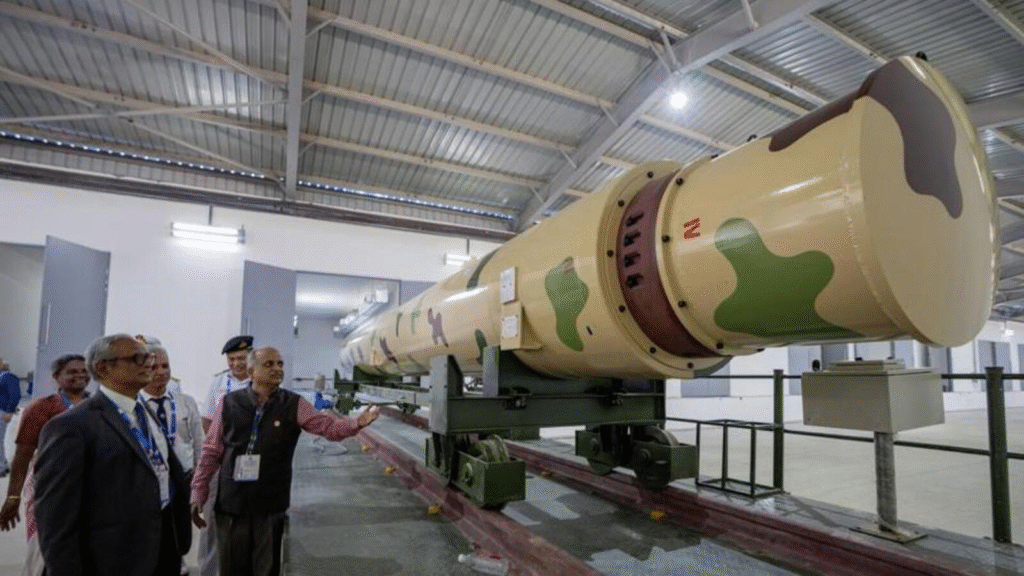
- After becoming fully operational, the Lucknow unit successfully produced its first batch of BrahMos missiles, ready for dispatch and operational deployment.
- On October 18, 2025, the flag‑off ceremony saw the defence minister and the state chief minister inaugurate the full rollout of this batch.
- During the event, dignitaries witnessed demonstrations of booster docking, pre‑dispatch inspections, avionics, airframe presentations, mobile autonomous launcher exhibits, and a storage trolley showcase.
- The launch symbolizes not just the physical dispatch of the missiles but the fulfillment of a larger strategic, industrial, and geopolitical vision.
Significance & Strategic Implications

Self‑Reliance in Defence Manufacturing
This event highlights that India is moving from import dependencies to real indigenous production — not just assembling parts, but manufacturing advanced, lethal systems locally. That strengthens national security, reduces foreign vulnerabilities, and enhances sovereignty over the supply chain.
Defence Minister Rajnath Singh emphasized that this move is aligned with India’s strategic ambitions, reiterating that no inch of adversarial territory is beyond the reach of its strategic capabilities.
Boost to the Uttar Pradesh Defence Corridor
The Lucknow facility is one of the flagship projects in the UP Defence Corridor, and the successful rollout amplifies the region’s emergence as a strategic industrial hub. Employment, revenue (e.g. GST), and regional development are set to accelerate.
Strategic and Military Edge
With increased local production of BrahMos, India strengthens its operational readiness and deterrence posture. More missiles produced domestically mean faster replenishment, reduced logistical constraints, and enhanced capacity to sustain operations under conflict conditions.
Moreover, by increasing the supply of a high‑end strike weapon system, India may be better positioned vis‑à‑vis regional security dynamics.
Economic, Regional & Social Impact

Employment & Skill Development
The facility requires engineers, technicians, quality control specialists, logisticians, and support staff. That means skilled jobs for local youth in and around Lucknow and the UP corridor. The ripple effect on allied sectors — metallurgy, electronics, defence support services — is significant.
Fiscal and Revenue Gains
Production will generate GST revenues for Uttar Pradesh and broader economic gains in ancillary services, infrastructure, and logistics. The state stands to benefit from the industrial multiplier across transport, housing, education, and support sectors.
Regional Industrial Ecosystem
This missile plant complements other defence and aerospace units in UP (e.g. drone manufacturing, materials plants). The ecosystem synergy will attract investment, technology transfers, and global strategic partnerships.
Symbolic & Political Messaging
For UP and its leadership, the facility is a showcase of modernity, industrial capability, national contribution, and political capital. It reinforces narratives of UP being a leader in India’s industrial transformation and defence sector prominence.
Challenges & Future Prospects
Scaling & Production Challenges
Producing 80–100 missiles annually is ambitious, but future demand — especially for next‑generation variants — may require scaling well beyond those numbers. Material supply, component precision, yield quality, and international collaboration will be crucial.
Quality Assurance & Reliability
Missiles are unforgiving. Achieving consistent high standards, testing under extreme conditions, and ensuring zero failure rates demand rigorous QC, testing, and feedback loops.
Export Potential & Strategic Partnerships
Once domestic supply is stable, the facility may aim to produce for export markets. Strategic partnerships, defence diplomacy, and compliance with international regimes (MTCR, etc.) will shape how that expansion proceeds.
Upgrading Technology & Next‑Generation Missiles
BrahMos is set to evolve — lighter versions, air‑launched variants, extended range, multi‑platform deployment. The facility must adapt to these demands and be modular, flexible in design and upgradeability.
The Ceremony & Key Highlights
Below are some of the ceremonial and symbolic elements that stood out:
- Inauguration of Booster Building and demonstration of booster docking
- Airframe & avionics presentations
- Pre‑Dispatch Inspection (PDI) and Warhead Building review
- Simulator demonstrations, storage trolley exhibits, autonomous launchers
- A tree plantation drive, GST‑bill presentation, and cheque to state government gesture
- Symbolic messaging of “Make in India, Make for the World” and UP’s partnership in national security
These elements conveyed both technological depth and political symbolism.
What This Means for India & The Road Ahead
A Shift in National Defence Strategy
India is signaling that it is ready to manufacture cutting-edge systems at scale. No longer just a consumer, India is positioning itself as a defence systems builder and exporter. The Lucknow BrahMos rollout is one visible testimony of that shift.
Strengthening Deterrence & Strategic Autonomy
With local production, activation timelines reduce, supply chain risks diminish, and operational flexibility increases. In crises or conflict, this capacity is vital.
UP as a Defence Manufacturing Powerhouse
Lucknow’s success can catalyse further development in UP. More facilities, allied industries, maintenance hubs and global collaborations may follow.
International Diplomacy & Export Reach
In time, India may export BrahMos or derivatives to friendly nations under strategic frameworks. If successful, that not only aids diplomacy but also offsets costs through export revenues.
Technological Innovation & Iteration
The facility must evolve with technologies: AI, precision navigation, materials science, miniaturization, multi‑domain deployment. The roadmap ahead is intense.
Conclusion
The flagging off of the first batch of Lucknow‑manufactured BrahMos missiles by Rajnath Singh and CM Yogi Adityanath is more than a defence event — it is a symbolic, strategic, industrial, and political milestone. It underscores India’s resolve to indigenize advanced weapon systems, strengthen self-reliance, and bring defence manufacturing closer to home.
For the armed forces, it means faster supply, better readiness, and strategic depth. For Uttar Pradesh, it’s a major industrial leap, job generation, and regional prestige. For India’s global standing, it’s a statement: it’s ready to build, deploy, and even export advanced defence systems.
As this first batch heads out, the real test lies ahead: scaling up, maintaining quality, evolving to new variants, and integrating this capability into the full span of India’s defence posture. But the foundations are now live — and they’re live in Lucknow.