

 Categories

Rahul Gandhi levels a grave charge overseas: accuses India’s ruling BJP of a proposal to eliminate the Constitution. We break down the Berlin speech and its implications.
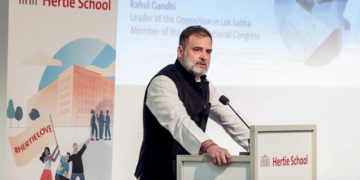
Leader of Opposition in the Lok Sabha and Congress leader Rahul Gandhi addresses a gathering during a visit to the Hertie School, in Berlin, Germany. (X/@INCOverseas via PTI Photo)
Senior Congress leader and Leader of Opposition in the Lok Sabha, Rahul Gandhi, has sparked a major political debate after accusing the Bharatiya Janata Party (BJP) of proposing the “elimination of the Indian Constitution.” Speaking during an interaction with members of the Indian diaspora in Berlin, Germany, Gandhi alleged that the ruling party’s actions and ideology pose a direct threat to constitutional values such as democracy, secularism, and social justice.
His remarks, delivered during an overseas visit aimed at engaging with the Indian community and international stakeholders, have triggered sharp reactions from the BJP, reignited ideological fault lines in Indian politics, and brought constitutional issues back to the center of national discourse.
Rahul Gandhi’s Statement in Berlin
Addressing a gathering of Indian expatriates, students, and professionals in Berlin, Rahul Gandhi claimed that the BJP and its ideological affiliates were systematically undermining the Constitution of India.
According to Gandhi, the Constitution is not merely a legal document but a social contract that guarantees equality, freedom, and dignity to every Indian citizen. He argued that recent political developments indicate an attempt to weaken this framework.
He stated that the Constitution, drafted under the leadership of Dr. B. R. Ambedkar, protects marginalized communities and ensures a balance of power. Any move to dilute it, he said, would fundamentally alter the nature of the Indian republic.
Gandhi’s comments came as part of a broader critique of what he described as the concentration of power, erosion of democratic institutions, and suppression of dissent under the current government.
Photo suggestions
- Rahul Gandhi addressing the Indian diaspora at an event hall in Berlin
- Audience members listening during the interaction
Context of the Berlin Visit
Rahul Gandhi’s Berlin engagement was part of a broader international outreach program aimed at connecting with the Indian diaspora and discussing India’s political and economic trajectory.
During the visit, Gandhi interacted with academics, policy experts, and members of civil society. His discussions focused on democracy, employment, social justice, and India’s global standing.
The Congress leader has previously used international platforms to raise concerns about democratic backsliding in India, arguing that global engagement is essential in a connected world. His Berlin remarks follow similar statements made during earlier visits to the United Kingdom and the United States.
The Constitutional Argument
At the heart of Gandhi’s speech was the argument that the Indian Constitution is under threat. He alleged that the BJP’s ideological framework prioritizes a narrow interpretation of nationalism over constitutional pluralism.
He pointed to debates surrounding secularism, federalism, and affirmative action as evidence of what he termed a “systematic effort” to reshape the constitutional order.
Gandhi emphasized that the Constitution was designed to protect diversity and prevent the dominance of any single ideology. He warned that undermining this structure could marginalize vulnerable communities and weaken democratic safeguards.
BJP’s Response and Counter-Allegations
The BJP strongly rejected Rahul Gandhi’s claims, accusing him of spreading misinformation and damaging India’s image abroad.
Senior BJP leaders argued that the Constitution remains fully intact and that the government has worked within its framework while pursuing reforms. They accused Gandhi of politicizing constitutional issues for electoral gain and questioned the appropriateness of raising such allegations on foreign soil.
BJP spokespersons stated that the ruling party has upheld constitutional processes, pointing to parliamentary debates, judicial oversight, and democratic elections as evidence of institutional strength.
Some BJP leaders also accused Gandhi of disrespecting democratic mandates by questioning the legitimacy of a government elected by a large majority.
Photo suggestions
- BJP leaders addressing the media in New Delhi
- Parliament building or Supreme Court of India imagery
Political Reactions Across the Spectrum
The remarks triggered mixed reactions across India’s political spectrum.
Opposition parties largely echoed Gandhi’s concerns, stating that constitutional values such as freedom of expression and federal autonomy have been weakened in recent years. Several leaders welcomed the international attention drawn to these issues.
On the other hand, leaders from the ruling coalition dismissed the comments as exaggerated and politically motivated. They argued that India’s institutions remain robust and that criticism abroad undermines national unity.
Political analysts noted that Gandhi’s statements align with a broader opposition narrative that seeks to frame the upcoming political battles as a fight to “save the Constitution.”
The Role of the Indian Diaspora
Gandhi’s choice of addressing the Indian diaspora in Berlin was significant. Overseas Indians often play an influential role in shaping global perceptions of India.
During the interaction, several audience members raised questions about economic inequality, employment opportunities, and the future of democracy in India. Gandhi responded by stressing the importance of constitutional safeguards in ensuring inclusive growth.
The event highlighted how diaspora platforms are increasingly becoming spaces for political debate rather than just cultural exchange.
Photo suggestions
- Indian diaspora members attending the Berlin event
- Cultural or community banners at the venue
Constitutional Politics in Contemporary India
The Constitution has become a central theme in Indian political discourse in recent years. Issues such as reservation policies, citizenship laws, and the role of federal states have sparked intense debate.
Rahul Gandhi and the Congress have positioned themselves as defenders of constitutional values, frequently invoking Dr. Ambedkar and the founding principles of the republic.
The BJP, meanwhile, argues that constitutional reforms and reinterpretations are part of a natural democratic evolution and denies any attempt to dismantle the constitutional order.
This clash reflects deeper ideological differences about nationalism, governance, and social structure.
International Reactions and Diplomatic Sensitivities
While Gandhi’s remarks were primarily aimed at an Indian audience, they also carried international implications. Foreign observers and media outlets closely watch statements made by senior Indian politicians abroad.
The Indian government has traditionally maintained that internal political debates should not be internationalized. BJP leaders criticized Gandhi for airing domestic disputes overseas, arguing that it could be misinterpreted by foreign governments.
Supporters of Gandhi countered that global engagement on democratic values is legitimate in an interconnected world.
Historical Significance of the Constitution
The Indian Constitution, adopted in 1950, is one of the longest and most comprehensive constitutions in the world. It enshrines fundamental rights, outlines the structure of government, and guarantees social justice.
Dr. B. R. Ambedkar, its chief architect, envisioned it as a living document capable of adapting while protecting core values.
Any political debate around its interpretation or amendment carries deep emotional and historical weight, making Gandhi’s allegation particularly significant.
Electoral Implications
Political observers believe Gandhi’s statement is also part of a broader electoral strategy. By framing the political contest as a struggle to protect the Constitution, the opposition aims to mobilize voters across caste, class, and regional lines.
The BJP, on the other hand, continues to focus on development, governance, and national security as its core themes.
As election cycles approach, constitutional rhetoric is expected to intensify, shaping campaign narratives and public discourse.
Media and Public Debate
The Berlin remarks dominated Indian news cycles and social media platforms, with hashtags and opinion pieces reflecting polarized reactions.
Supporters praised Gandhi for raising constitutional concerns boldly, while critics accused him of exaggeration and political opportunism.
The debate underscored the growing role of international engagements in domestic political messaging.
Rahul Gandhi’s allegation in Berlin that the BJP is proposing the elimination of the Indian Constitution has added a new dimension to India’s ongoing political debate. Whether seen as a warning about democratic erosion or as a politically charged accusation, the statement has succeeded in refocusing national attention on constitutional values.
As reactions continue to unfold, the controversy highlights the central role the Constitution plays in India’s political identity and the intensity of ideological battles shaping the country’s future.
The coming months will reveal whether this narrative resonates with voters or further deepens political polarization.
Also Read : Diplomatic Face-Off with India, Angry Protests Spill to Kolkata: Inside the Bangladesh Unrest