

 Categories
Eight killed and 14 injured in a tragic truck accident in Pune. Get the latest updates, eyewitness details, investigation reports, and official statements on the devastating highway crash.
1. The Incident Unfolds
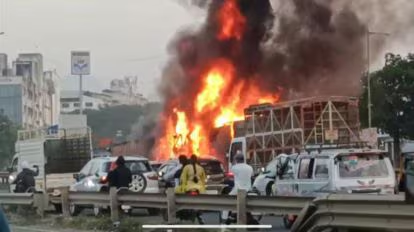
A horrifying tragedy struck near the outskirts of Pune on Thursday evening, when a heavy-goods vehicle lost control on the busy Navale Bridge stretch of the Mumbai–Bengaluru National Highway, sending shockwaves through the city and the region. Initial official reports confirm that eight people have died and 14 others are injured in the catastrophic collision.
According to police and fire-brigade sources, a laden container or goods truck—travelling from Satara towards Mumbai—reportedly experienced brake failure, lost control and ploughed into multiple vehicles on the bridge, including another large container truck and a car which became trapped between the two heavy vehicles.
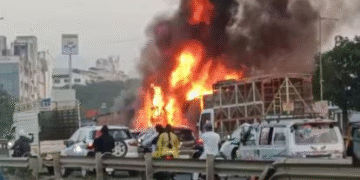
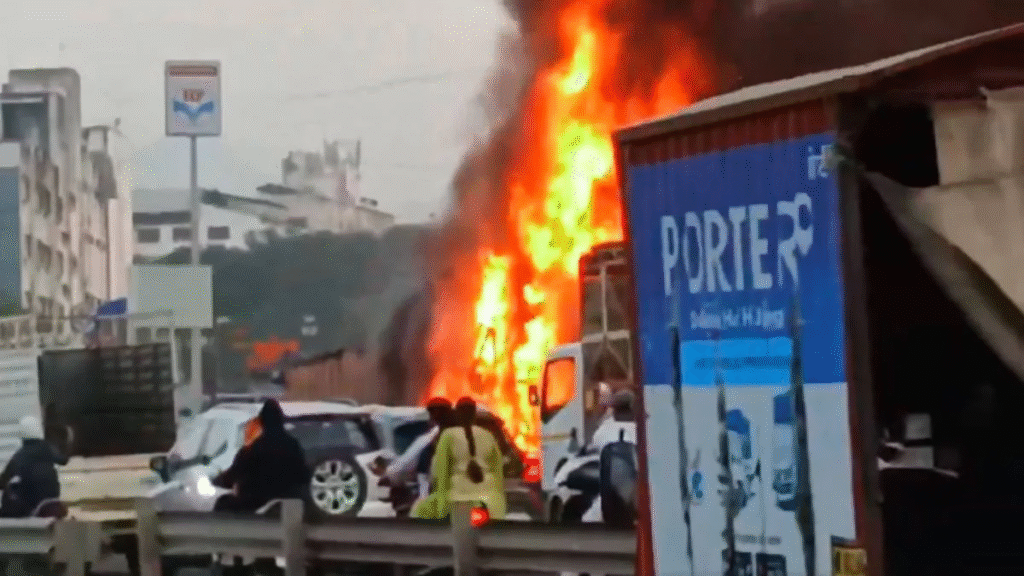
The impact triggered a massive fire: vehicles were engulfed, the car caught between the two trucks was crushed, and rescuers had to battle intense flames and thick smoke. Traffic on the highway came to an abrupt standstill, compounding the chaos and complicating rescue efforts.
2. Location & Why It Matters
The accident took place on the arterial National Highway connecting Mumbai and Bengaluru, at the Navale Bridge location — a stretch that has drawn scrutiny for frequent heavy-vehicle mishaps.
In its role as a major freight corridor for trucks entering or leaving the city of Pune, this route sees a high volume of heavy-load traffic, often descending slopes or negotiating curves. The combination of speed, downhill gradients, heavy loads and traffic merges makes the zone particularly vulnerable.
Because of the scale of vehicles involved (large container trucks), the speed of the crash and the subsequent fire, the incident has immediate consequences:
- Loss of life and injuries on a major route
- Disruption to one of the region’s busiest freight + passenger corridors
- Urgent questions about safety measures, enforcement, vehicle maintenance, driver training and road design
3. The Victims and Response
At the time of reporting, eight fatalities have been confirmed, with 14 injured sent to nearby hospitals in critical condition.
The victims include occupants of the car crushed between the trucks as well as others in vehicles caught up in the chain-collision and blaze. Identifying remains has been made harder by the intensity of the fire.
Fire and rescue teams arrived swiftly: multiple fire-tenders and tankers were deployed to fight the blaze, rescue trapped victims and recover bodies. Ambulances and medical teams transported injured to hospitals.
Authorities moved quickly to cordon off the area and redirect traffic, though the highway remained heavily congested for hours, impeding rescue operations and compounding the logistical challenge.
4. What Went Wrong? Possible Causes Under Investigation
The preliminary probe suggests the following scenario:
- A container truck, heavily loaded and descending the Navale Bridge stretch, suffered brake failure or loss of control.
- The truck rammed into one or more vehicles, and in the sequence of collisions, a car became trapped between two heavy vehicles.
- The resulting impact, combined with what appears to be a CNG-kit explosion inside the car or fuel ignition, triggered a massive fire that consumed several vehicles.
- Heavy damage and flames significantly hampered rescue efforts.
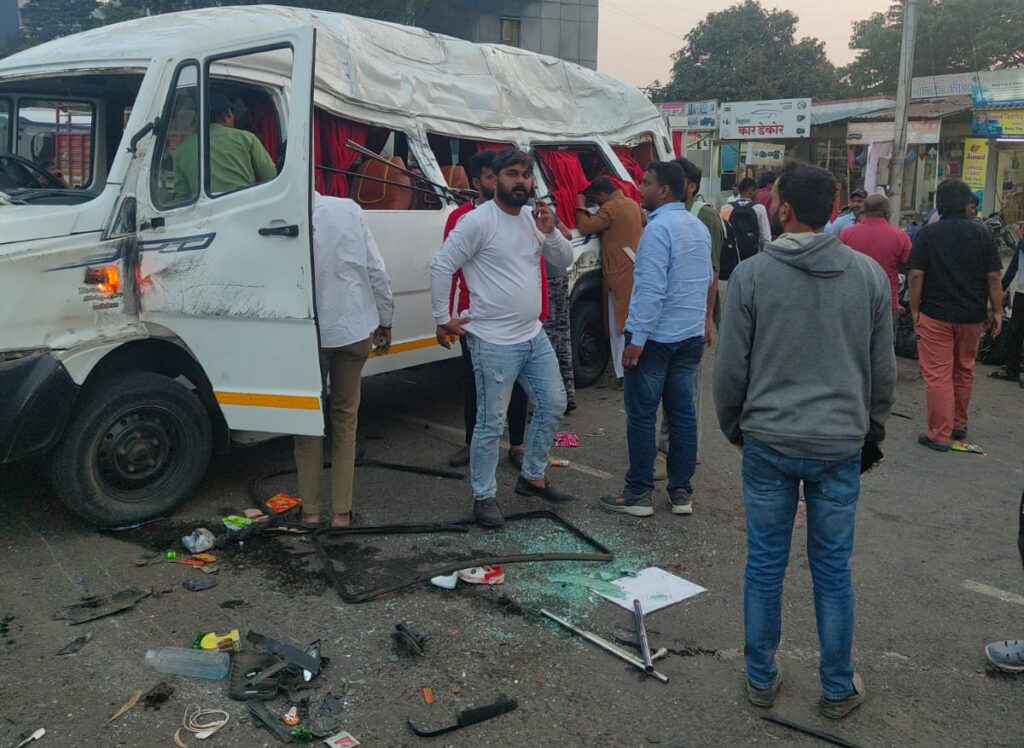
While brake failure is being treated as a likely trigger, investigators are exploring additional factors: overloaded trucks, excessive speed, road design/slope, disciplinary checks of heavy-vehicle maintenance and driver rest or fatigue.
5. The Aftermath – Immediate and Broader Impact
Immediate Response:
- The fire and rescue teams were deployed immediately; the city’s fire-brigade chief confirmed arrival of multiple units.
- Injured victims are being treated in hospitals; some remain in critical condition, raising the possibility of further fatalities.
- Authorities have announced compensation/grants for families of the deceased. The Chief Minister mentioned ex-gratia payments.
- The highway remained closed or partially blocked for hours, causing major disruption to traffic and freight movement.
Broader Impact:
- The accident highlights the vulnerability of high-volume freight corridors to catastrophic failure when things go wrong.
- It raises serious questions about heavy-vehicle regulation, the maintenance of brakes and tires, load limits, driver training, and enforcement.
- Road design issues — steep descents, lack of runaway vehicle escape zones, heavy traffic mixing with fast-moving freight — come under scrutiny.
- The social cost of such accidents: families destroyed, victims facing life-changing injuries, economic impact on freight supply chain, reputation of road safety in the region.
- For Pune region and Maharashtra, it becomes a wake-up call: despite repeated tragedies at this very bridge/route, why do such massive accidents still occur? Reddit discussions and local voices point to recurring patterns.
6. Voices from the Ground
Local commuters, residents and emergency-responders have been deeply affected. One local user on Reddit noted:
“Every few weeks it’s the same story — trucks lose control, people die, and nothing changes.”
Emergency-service staff described a harrowing scene: “When we arrived, the car was trapped between two container trucks; flames were towering, bodies charred, vehicles mangled. It took every fire-tender we had to bring it under control.”
Residents living in lanes adjacent to the highway said: “We live with the fear of heavy trucks coming down the slope at high speed. We’ve asked for speed-breakers, warning signs, but nothing concrete has been done.”
7. What Needs to Happen — Lessons & Recommendations
From this tragedy, a number of key measures emerge that require urgent attention:
Vehicle & Driver Safety:
- Mandatory maintenance check-ups for heavy-goods vehicles, especially brakes & tires.
- Strict enforcement of load limits; overloaded trucks increase stopping distance and risk of mechanical failure.
- Driver training, especially for descent zones: safe speed management, use of engine-brake, avoiding over-reliance on service brakes.
- Mandatory tachograph/vehicle monitoring to track speed, braking events, driver hours.
Road Engineering & Traffic Management:
- Identify high-risk stretches such as declining gradients, tight curves, high-volume freight corridors and implement remedial engineering: runaway lanes, stronger guard-rails, speed-calming infrastructure.
- Separate freight traffic from regular traffic where feasible; designate heavy-truck routes or timing restrictions.
- Early warning systems: signage warning of steep descent, mandatory brake-check zones, runaway-truck escape lanes.
- Emergency-rescue infrastructure on high-volume highways: fire-tender stations, medical-response posts, quickly deployable crane/clearance units.
Regulatory & Institutional Strengthening:
- Robust oversight of heavy-vehicle fleets: periodic audits, certificate renewals, surprise inspections.
- Stronger penalties for flaws: driver negligence, non-maintenance, overloaded vehicles.
- Data-driven approach: track accident-prone zones, collect cause-data, publish safety audits to drive accountability.
- Public-private collaboration: trucking companies must share safety data, adopt best-practices, invest in safety upgrades.
Public Awareness & Community Involvement:
- Road users must be aware of heavy-vehicle risks: maintain safe distance, avoid lingering on slopes, never overtake recklessly.
- Local residents and commuters can act as watchdogs: report overloaded trucks, maintenance lapses, frequent near-misses.
- Media and civic groups should sustain pressure for change; each tragic incident should translate into reform, not just reportage.
8. Why This Occurred Here — The Navale Bridge Curse?
The Navale Bridge stretch has earned a reputation for recurring heavy-vehicle accidents. Reddit users and local commentators suggest that the “design plus descent” formula creates a latent disaster waiting to happen.
This accident fits the pattern: loaded truck descending, brake failure or speed gain, collision into slower/regular vehicles, fire/blaze amplifying the damage. The fact that the car was trapped between two huge trucks underscores the scale and severity.
The pattern begs fundamental questions:
- Why hasn’t comprehensive redesign/hazard-mitigation been carried out yet?
- Are truck-standards sufficiently enforced before descent begins?
- Are emergency-response protocols and infrastructure matched to the high-risk character of the zone?
9. A Lasting Wake-up Call
This horrific loss of eight lives and injuries to many others should not fade into the annals of tragic statistics. It must serve as a catalyst for multi‐agency action: road engineers, trucking companies, traffic police, vehicle‐inspectors, urban planners and the public at large.
The families of the deceased — whose names will soon be released — are owed not only compensation, but accountability and systemic change. Injured victims face long-term rehabilitation, psychological trauma and uncertainty; their recovery and support must be priority.
The highway is a lifeline of commerce and connectivity, but when a single mechanical failure invokes such devastation, we must ask: who pays the price, and who will act to prevent the next one?
10. Conclusion
On this tragic evening in Pune, a chain-reaction collision involving container trucks and a car on the Navale Bridge claimed eight lives and left over a dozen injured. The immediate cause looks to be brake failure in a heavy truck on a descent, leading to a fiery wreck. While rescue efforts have commenced and compensation has been announced, the bigger fight remains out of sight: making roads, vehicles and systems safe.
As the charred wreckage is cleared and traffic resumes, into the silent after-shock we must carry forward the memory of those lost — not as victims of a moment, but as catalysts for a safer tomorrow. The lessons here are heavy; the cost has been far heavier still.
Also Read : Death Count In Delhi Blast Near Red Fort Rises To 13, Say Police