

 Categories
Mumbai faces a mounting garbage crisis as uncollected waste raises public health alarms and environmental concerns across the city.
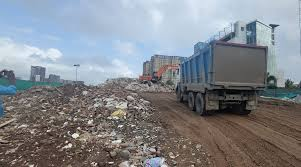
A nearly 10 feet tall garbage piled up on the land which lies between the school campus in Bandra Kurla Complex’s F-Block and Mithi River.
Mumbai, India’s financial capital and home to more than 1.2 crore residents, produces dreams, wealth, culture—and an overwhelming amount of garbage. Every single day, the city generates over 6,500 to 7,000 metric tonnes of solid waste, a figure that continues to rise with population growth, consumption patterns, and rapid urbanisation. What was once a manageable civic challenge has now turned into a full-blown environmental, health and governance crisis, with garbage heaps spilling onto roads, choking drains, polluting air, and raising a literal and metaphorical stink across the metropolis.
From towering landfill mountains to uncollected waste on residential streets, Mumbai’s garbage problem is no longer hidden on the city’s fringes—it is right outside people’s homes.
A City Drowning in Waste
Mumbai’s waste story begins at the household level but ends in some of the city’s most controversial sites: Deonar, Mulund, and Kanjurmarg dumping grounds. Among these, Deonar—Asia’s oldest landfill—has become a symbol of civic failure.
Key Numbers at a Glance
- Daily waste generation: ~6,500–7,000 metric tonnes
- Population served: Over 12 million
- Landfills nearing saturation: Deonar, Mulund
- Waste segregation compliance: Inconsistent across wards
Despite repeated promises by civic authorities to move towards scientific waste management, open dumping and landfill dependency continue to dominate Mumbai’s system.
Landfills: Mountains of Rotting Trash
Deonar Dumping Ground
Once envisioned as a temporary solution, Deonar has been operational for decades. Today, it resembles a toxic hill, rising several storeys high, emitting methane, smoke, and a persistent stench.
Residents living nearby report:
- Chronic respiratory illnesses
- Skin infections
- Water contamination
- Frequent landfill fires
The garbage here is a dangerous mix of organic waste, plastic, biomedical refuse, and construction debris, often dumped without adequate segregation.
Mulund and Kanjurmarg
Mulund landfill has officially crossed its capacity, while Kanjurmarg is now under pressure as Mumbai looks for alternatives. Proposals for waste processing plants at these sites have repeatedly run into environmental protests, legal challenges, and political opposition.
The Human Cost: Health and Livelihoods at Risk
For people living near dumping grounds, garbage is not an abstract issue—it is a daily health hazard.
Doctors in surrounding areas report higher incidences of:
- Asthma and bronchitis
- Tuberculosis
- Gastrointestinal infections
- Vector-borne diseases like dengue and malaria
Children and elderly residents are especially vulnerable. Add to this the plight of sanitation workers, many of whom work without adequate protective gear, facing exposure to toxic substances every day.
Stinking Streets and Overflowing Bins
The problem isn’t confined to landfills. Across Mumbai:
- Community bins overflow for days
- Waste is dumped illegally on pavements
- Markets and slums struggle with irregular collection
- Construction debris clogs footpaths and drains
During monsoon, the situation worsens as garbage:
- Blocks stormwater drains
- Leads to waterlogging
- Exacerbates flooding
- Creates breeding grounds for mosquitoes
Residents frequently complain that waste collection is uneven, with affluent areas receiving better services than dense, low-income neighbourhoods.
Why Is Mumbai Failing at Waste Management?
1. Poor Segregation at Source
Although segregation into wet and dry waste is mandatory, compliance remains patchy. Many households still dump mixed waste, making recycling and composting difficult.
2. Overdependence on Landfills
Instead of processing waste at source, Mumbai continues to rely heavily on landfills—a model widely considered outdated and unsustainable.
3. Lack of Waste-to-Energy Success
Several waste-to-energy and biomethanation projects have been announced, but many remain delayed, underperforming, or controversial due to emissions concerns.
4. Administrative and Contractual Issues
Multiple contractors, overlapping responsibilities, and weak accountability mechanisms have led to inefficiencies in collection, transport, and processing.
5. Rising Plastic and Packaging Waste
The explosion of online deliveries, food packaging, and single-use plastics has added a new dimension to Mumbai’s garbage woes.
Civic Body Under Pressure
The Brihanmumbai Municipal Corporation (BMC)—India’s richest civic body—has repeatedly promised long-term solutions:
- Closure of Deonar landfill
- Expansion of waste processing facilities
- Increased composting and recycling
- Scientific capping of landfill sites
However, progress has been slow and uneven. Deadlines for landfill closure have been pushed repeatedly, raising questions about planning and execution.
Civic officials argue that:
- Finding land in Mumbai is extremely difficult
- Public opposition delays new projects
- Waste generation is rising faster than infrastructure
Critics counter that lack of political will and citizen engagement is the real problem.
Environmental Fallout: More Than Just a Smell
Garbage isn’t just ugly or smelly—it is a serious environmental threat.
Air Pollution
Landfill fires release:
- Methane
- Carbon monoxide
- Toxic particulate matter
These emissions contribute to Mumbai’s worsening air quality.
Water Pollution
Leachate from dumping grounds seeps into:
- Groundwater
- Nearby water bodies
- Storm drains
This threatens both drinking water sources and marine ecosystems.
Climate Impact
Organic waste decomposing in landfills produces methane, a greenhouse gas far more potent than carbon dioxide, contributing to climate change.
Citizen Anger and Activism
Across Mumbai, resident welfare associations, environmental groups, and local activists have been raising the alarm:
- Protests against new dumping grounds
- Legal challenges demanding landfill closure
- Campaigns for segregation and composting
Social media is filled with images of overflowing garbage bins and black smoke from landfill fires, putting pressure on authorities to act.
Some neighbourhoods have taken matters into their own hands, adopting:
- Community composting
- Zero-waste initiatives
- Plastic-free campaigns
But such efforts remain limited in scale without citywide support.
What Other Cities Are Doing Differently
Cities like Indore and Pune have demonstrated that better waste management is possible through:
- Strict segregation enforcement
- Door-to-door collection
- Decentralised composting
- Citizen participation
Mumbai’s scale is larger, but experts argue that the principles remain the same—reduce, reuse, recycle.
The Way Forward: Can Mumbai Clean Up?
Experts suggest a multi-pronged approach:
1. Enforce Segregation
Penalties for non-compliance and incentives for good practices.
2. Decentralise Waste Processing
Smaller composting and recycling units across wards to reduce landfill dependency.
3. Reduce Plastic Use
Stricter enforcement of plastic bans and promotion of alternatives.
4. Upgrade Worker Safety
Protective equipment, health insurance, and dignity for sanitation workers.
5. Transparency and Accountability
Public dashboards tracking waste collection, processing, and landfill capacity.
Conclusion: A Wake-Up Call for India’s Financial Capital
Mumbai’s garbage crisis is no longer just a civic inconvenience—it is a public health emergency, an environmental hazard, and a test of urban governance. The stench rising from landfills and streets is a reminder that economic growth without sustainable planning comes at a steep cost.
Cleaning up Mumbai will require more than contracts and machines. It will demand political courage, administrative reform, and active citizen participation. Until then, the city that never sleeps will continue to wake up each morning to the same uncomfortable reality: its garbage problem is growing faster than its solutions.