

 Categories
Navi Mumbai International Airport begins flight operations, opening a new gateway to the MMR. Check flight schedules, connectivity, and what this new airport means for Mumbai’s air travel expansion.
Navi Mumbai:
In a landmark moment for India’s aviation and infrastructure landscape, the Navi Mumbai International Airport (NMIA) has officially commenced flight operations, marking the beginning of a new era in air connectivity for the Mumbai Metropolitan Region (MMR). With its inauguration, NMIA becomes the country’s second major greenfield airport in Maharashtra and a long-awaited relief to the heavily congested Chhatrapati Shivaji Maharaj International Airport (CSMIA) in Mumbai.
The start of operations at Navi Mumbai International Airport is expected to significantly enhance passenger capacity, boost regional economic growth, and strengthen Mumbai’s position as a global aviation and business hub. The airport has been designed to handle both domestic and international flights, with phased expansion plans that aim to make it one of the largest and most advanced airports in India.
A Long-Awaited Infrastructure Milestone
The operational launch of NMIA is the culmination of nearly two decades of planning, land acquisition, environmental clearances, and large-scale engineering efforts. Conceived to address the growing air traffic demand of Mumbai and surrounding regions, the airport was developed as a public-private partnership led by Mumbai International Airport Limited (MIAL), a subsidiary of the Adani Group, in collaboration with the City and Industrial Development Corporation (CIDCO).
Officials described the commencement of flight operations as a historic milestone that would redefine air travel in western India. Initial services include domestic flights connecting major Indian cities, with international operations expected to be rolled out in subsequent phases.
Strategic Importance for the Mumbai Metropolitan Region
The Mumbai Metropolitan Region, which includes Mumbai, Navi Mumbai, Thane, Raigad, and Palghar districts, is home to more than 26 million people and contributes significantly to India’s economy. Until now, the region relied primarily on a single major airport—CSMIA—operating at near-maximum capacity.
Navi Mumbai International Airport is strategically located near Ulwe and Panvel, offering better accessibility to residents of Navi Mumbai, Thane, Kalyan-Dombivli, Panvel, and Raigad. The new airport is expected to drastically reduce travel time for passengers from these areas and ease pressure on Mumbai’s road and rail networks.
Urban planners believe NMIA will act as a growth catalyst, encouraging the development of new business districts, logistics hubs, hospitality projects, and residential zones across Navi Mumbai and its adjoining regions.
State-of-the-Art Infrastructure and Design
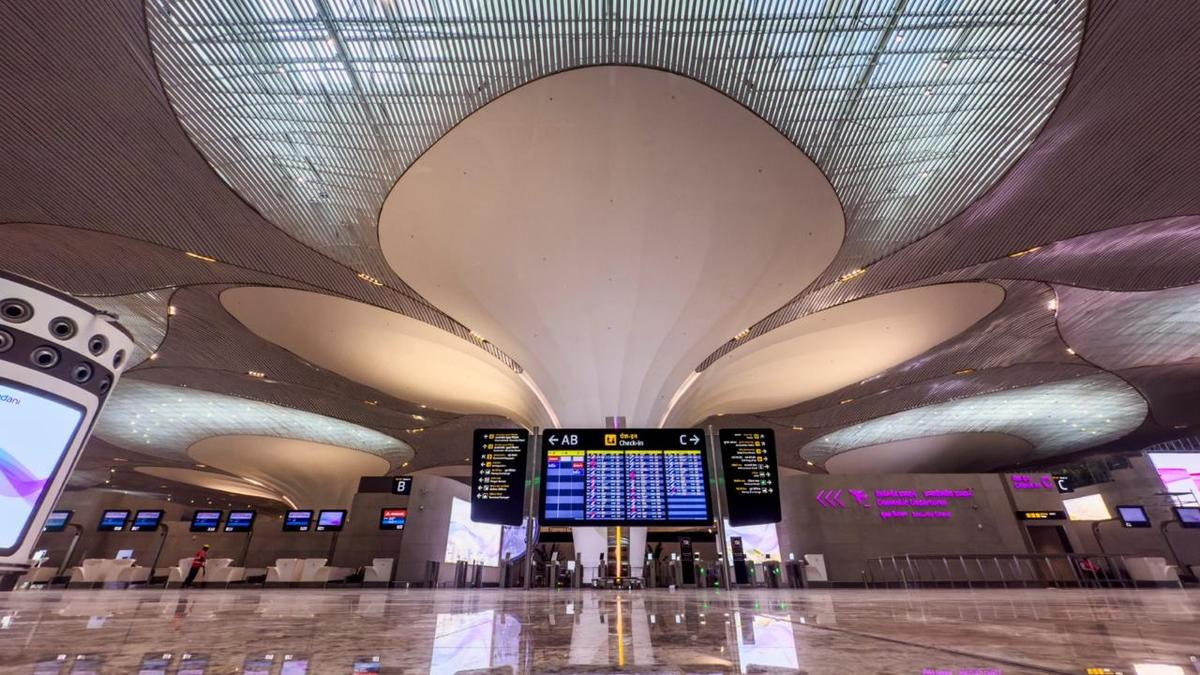
Navi Mumbai International Airport has been built with a strong focus on modern design, sustainability, and passenger convenience. The airport’s terminal architecture reflects a blend of functionality and aesthetics, inspired by India’s natural and cultural heritage.
Key features of the airport include:
- A modern passenger terminal with high-capacity check-in counters
- Advanced baggage handling systems
- Multiple aerobridges and wide-body aircraft compatibility
- Digitally integrated security and immigration facilities
- Dedicated cargo terminals to support logistics and exports
The airport has been designed to handle millions of passengers annually in its initial phase, with scalability built into its master plan to accommodate future growth.
Runways and Airside Capabilities
NMIA features a unique dual-runway system designed for efficient aircraft movement and reduced delays. The parallel runways enable simultaneous take-offs and landings, a capability that significantly enhances operational efficiency.
The airport is equipped with advanced navigation and air traffic management systems, allowing safe operations under varying weather conditions. Aviation experts say the airport’s layout and infrastructure align with global standards, making it suitable for international carriers and long-haul operations.
Boost to Domestic and International Connectivity
With the commencement of flight operations, Navi Mumbai International Airport is expected to expand connectivity across India and beyond. Domestic airlines have begun operating select routes, while international carriers are expected to follow as immigration and customs infrastructure becomes fully operational.
The airport is also poised to become a key hub for low-cost carriers, offering competitive landing charges and operational efficiencies. This could lead to increased flight frequencies, competitive airfares, and greater travel options for passengers.
Industry analysts believe NMIA will eventually serve as a major gateway for travelers from western and southern India heading to international destinations.
Cargo and Logistics Hub in the Making
Beyond passenger travel, Navi Mumbai International Airport is expected to play a critical role in cargo and logistics operations. The airport’s proximity to the Jawaharlal Nehru Port Authority (JNPA), India’s largest container port, gives it a strategic advantage for multimodal transport.
Dedicated cargo terminals and warehousing facilities are expected to support industries such as pharmaceuticals, electronics, perishables, and e-commerce. This integration of air, sea, and road transport is likely to boost exports and improve supply chain efficiency.
Economic Impact and Employment Generation
The operationalisation of NMIA is projected to generate significant economic benefits for Maharashtra and the broader MMR. Thousands of direct and indirect jobs are expected to be created across sectors including aviation, hospitality, logistics, retail, and ground handling services.
Local businesses in Navi Mumbai and Panvel are likely to benefit from increased footfall, tourism, and commercial activity. Real estate experts anticipate rising demand for residential and commercial properties in areas surrounding the airport.
Government officials highlighted that the airport would not only decongest Mumbai but also decentralise economic growth across the region.
Improved Passenger Experience
Passenger convenience has been a key focus in the airport’s design and operations. Wide concourses, intuitive signage, digital check-in systems, and streamlined security processes aim to reduce waiting times and improve the overall travel experience.
The airport will also feature a range of retail outlets, food and beverage options, lounges, and passenger amenities. Accessibility features for senior citizens and passengers with reduced mobility have been integrated into the terminal layout.
Connectivity and Transport Links
To ensure seamless access, NMIA has been integrated with multiple transport networks. Road connectivity has been enhanced through new highways and flyovers linking the airport to Mumbai, Thane, and Navi Mumbai.
Upcoming infrastructure projects include suburban rail links, metro connectivity, and dedicated airport express services. Once fully operational, these links are expected to significantly reduce travel time and improve last-mile connectivity for passengers.
Environmental and Sustainability Measures
The airport has incorporated several sustainability measures aimed at reducing its environmental footprint. These include rainwater harvesting systems, energy-efficient lighting, solar power integration, and eco-friendly building materials.
Environmental experts note that the airport’s development followed extensive environmental impact assessments, including river diversion, mangrove conservation measures, and rehabilitation of affected communities.
Challenges and the Road Ahead
While the launch of flight operations marks a major achievement, aviation authorities acknowledge that full-scale operations will be implemented in phases. Ensuring smooth coordination between airlines, ground services, and transport agencies will be critical in the initial months.
Managing traffic flow, maintaining service quality, and scaling operations to meet rising demand will be key challenges as the airport transitions into full capacity.
Conclusion
The commencement of flight operations at Navi Mumbai International Airport represents a transformative moment for India’s financial capital and its surrounding regions. As a new gateway to the Mumbai Metropolitan Region, NMIA is set to redefine air travel, drive economic growth, and strengthen India’s aviation infrastructure.
With its modern facilities, strategic location, and long-term expansion potential, Navi Mumbai International Airport is poised to play a pivotal role in shaping the future of air connectivity in western India.